Showing posts with label burundi. Show all posts

15 February 2012

selling beans


Owning a business is hard.


Marie can buy dried beans in big bags for about US.70cents per kilogram. She then carries those big bags to the market every day where she lays them all out on a table. At the table to her left, is a woman, selling dried beans. To her right, another table filled with dried beans. The competition makes it difficult to secure customers - and she must keep her prices low to attract buyers who will choose her table above the others. The beans she bought for US.70cents, she sells for US $1. Only a .30cent profit on each kilo, assuming she is able to sell them. And then, those small profits need to be split up into many directions - the rent for her market stall - the materials she needs to sell; bags to put people’s purchases into, a scale to measure her product on. She needs money set aside to be able to buy more beans when these are all sold - and then, if there is anything left, she can use that to take care of her family.


A loan from Turame Microfinance Bank, gave Marie the ability to start with the capital she had not been able to save up from her small profits. Capital she used to find different suppliers for her beans, suppliers who offered new varieties that would make her stand out from the competitors in the market and attract more customers. She was also able to buy in even larger quantities, which brought down her cost and instantly raised her profit margin. Now instead of making US.30cents profit on every kilo of beans she sells, she sees a profit of US.50cents - or even more on some of the fancier varieties. In her first loan cycle, she’ll have to use the extra profit to pay back her loan in every other week installments, and if she uses the rest of the profit to start a savings account, she’ll qualify for an even bigger loan in the next cycle. It will take a few cycles for her to begin seeing the rewards of her hard work - but by then, her business will have grown a lot - and she’ll find herself with a savings account full of her own capital so she no longer needs to borrow from a bank, but has the resources and new business training through Turame, to be independant and successful.

14 February 2012

"this is my story" (2)


“You have come to visit our lending group at a good time. A few months ago, I considered myself the least of all these people here. I wouldn’t have been able to go to any of them and ask to borrow BF10,000 (about $8) because I would know I could never earn enough to pay them back. But being invited to join the Pendo Community Lending Group has given me business training so I now have ideas on how to make my efforts a success instead of continuing to stay in a low place, always doing the same things but never getting ahead. And having the people in my lending group and a bank like Turame believe in me has given me the ability to see myself as also worthy. “


*paraphrased from translation

10 February 2012

Enjoy your weekend, friends....


may whatever you choose to do this weekend, bring you life - and the ability to generously share that life with the people who you find yourself next to.


we'll see you on Monday

photos taken at YFC's House of Hope - an orphan village in Burundi


11 January 2012

lending groups


Yesterday we went out to visit a repayment appointment for one of Turame's lending groups. We pulled up in our vehicles, past the mechanic's garages, past the seamstress district, past the small local outdoor factories where people sat grinding dried cassava tubers into flour. We pulled up to a modest concrete home belonging to one of the members of the group as they gathered to sing a song of welcome to our international guest, Peter Greer of Hope International. Peter has a long history with micro finance and is a co-author of the book "The Poor Will Be Glad - Joining the revolution to lift the world out of poverty" a book that really explains micro finance in understandable terms.


This particular lending group has been together for 4 years, continuing cycles of borrowing and repayment lasting for 6 months. They entire group gathers every two weeks to make their payments toward the balance of their collective loan, divided out between the individuals.

At one point, Peter asked what the best part about their Turame experience has been and one lady explained how good it has been to have the funds available for her to borrow, pay back and borrow more the next time. There is satisfaction in that and a feeling of accomplishment as each cycle is complete and they are once again trusted to borrow more money to further grow their businesses.
There were stories of fixing a home that had been crumbling, of sending children to school, of having more capital for their business making it easier to bring in a profit.
But after we left, I kept remembering the look on the woman's face as she spoke of the trust a bank had in her to borrow and repay. And how much she honored that responsibility because of the value behind it.
That statement just reemphasized that so often the issues of poverty are not steeped so deeply in material wealth as we tend to believe, but in self dignity.
Turame is working hard to not only feed into the financial needs of the vulnerable in Burundi, but also teaching spiritual, business and community values. They recognize that micro finance is a great tool, but can only take a person so far in their journey - because the root of humanity is woven together with something of such deeper value than just resources.


06 January 2012

a gallery of faces


this weekend i leave you with a gallery of faces to gaze into.
to understand that each of these faces represents a woman, in so many ways just like yourself -

a woman with a family, with a home, with dreams for her children, with the struggles of making her household run smoothly, with a deep love for God, with questions, with heartaches and with an impeccable sense of style.

I encourage you to take some space now and pray with me for each of these women, and if you will, for the many like these, who are now running small businesses of their own with the loans they've borrowed from Turame Mircofinance bank.

She may be selling bananas at a roadside stand or sewing dresses in her home. She could be making charcoal from local trees, cut down and buried with embers under the soil to smolder. She could own a small shop and serve the best goat stew lunch plates in the area. Small business are as unique as the gifting and dreams God has given each of us.

Maybe one face in particular strikes your heart.... you can pray for her specifically - even feel free to ask me for a larger version of her photo so you can print it out and put it in your bible or on your fridge and remember to keep praying. It's a beautiful thing we get to do here - to be a part of something so much bigger than ourselves. And you are a part of it too - as we continue to journey together in Burundi.


02 January 2012

we are gonna' talk a bit about micro finance this week

(ps- i have no idea what is going on with my font size today.. it's being stubborn as blazes. So I guess set your screen on enlarge and laugh with me, okay?)

so, you know that Billy and are spending this year at Turame MicroFinance in Bujumbura, Burundi. But we still get lots of questions as to what a micro finance bank actually is. I know is a bit of an anomaly to some of us in the United States with no real understanding of how micro finance works. It's a bank - yet it's somehow tied to an NGO -

this week let's visit again what microfiance is and how it helps the people here in Burundi coupled with photos from a lending group I was fortunate enough to visit. Today I'm recopying a description I found on MarsHill's website because I think it explains the concept very well - so forgive me if you've read this already... but I thought it well worth the reading to offer again.


In Burundi, Africa, one of the biggest hurdles in alleviating poverty is lack of capital. Yet, after a decade-long civil war, only a small percentage of people in Burundi have the collateral required to obtain it. Sitting at 166 out of 169 on the Human Development Index [which ranks countries by health, education, and income], the Burundian people are near to the world’s poorest.

Yet, there is hope. Turame Community Finance is a microcredit institution with pre-credit preparation trainings designed to increase a client’s capacity for credit policies and procedures. This training, combined with a social guarantee between members of the same group, serves in place of collateral, to open up the opportunity to obtain a microloan.

The loan application process begins by a potential Turame client submitting a business idea. Those who are approved receive a small amount of funds [typically around $60] to help build their business and generate a profit. With the profit earned, clients are not only able to pay back their loans but also provide for the needs of their families. One small loan impacts multiple lives.

Microloans provide the poor with the opportunity to work themselves out of poverty. Their small businesses are a permanent, sustainable means for independence instead of on-going reliance on external aid. As businesses grow, livelihoods improve, new opportunities are realized, and dignity is restored.
30 December 2011

the price of food


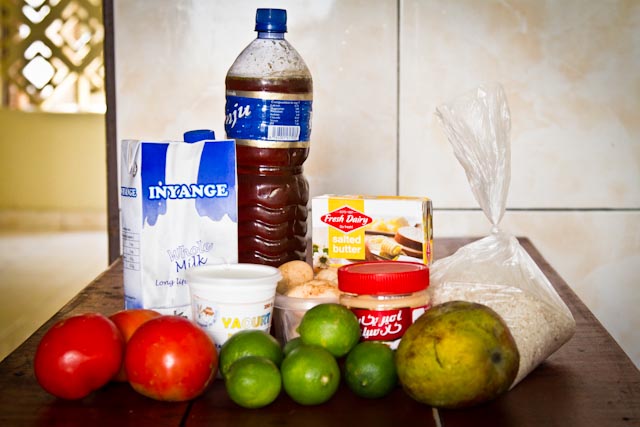
So today Billy and I went on an adventure. For the first time since I arrived in Burundi, we went to the grocery stores to see what is available here and to compare prices between the three main "muzungu" stores. I wasn't brave enough to take pictures inside the shops - but don't think Meijer - think walking into a 7Eleven - that's about the right size for these stores. Most people do their shopping at the local market or buy from street kiosks. We've found it is easier to send someone else to the market for us with a shopping list - prices seems to be lower when you are local in a system as fluid as the marketplace.

So, if you are interested, here's about what things cost here in Bujumbura::

small jar of peanut butter (imported)- $5
250g butter - $3
2.5lb chicken - $16
small bag pasta (imported)- $5
regular sized tub of ice cream (imported)- $22
pineapple - $1
large bunch of bananas - $3
1kg white rice - $1
1kg risotto rice (imported) - $9
box of cornflakes (imported) $10
1.5liter (recycled) bottle of local honey - $8.50
6 limes - 50cents
1kg fresh peas - 50 cents
1kg onions - $1
coconut - $2
single cookie Twix bar (imported)- $3
bottle of Malibu (imported)- $33
1kg dry beans - 90cents
1kg potatoes -$1
1kg green beans -$1
1 large avocado- $1
jar of nutela (imported) -$9
local eggs- 19cents each
loaf of homemade bread- 60 cents
deli ham , two large sandwich slices - $5


So, obviously, we are sticking with fresh local produce we can buy (or have bought for us) at the market. Lots of rice and beans instead of going for the imported things ...
it means our meals are simple. A baked potato with a side of peas for dinner. Mango, bananas and pineapple for a breakfast plate. Often times we go out for lunch to a local restaurant. For $2 we get a big plate of beans, rice, spinach and potatoes. It fills us up so much we just eat some popcorn for dinner.

I will admit though, last night I had a dream that my dear friend, Jen, came to visit me - and she brought cheese - and I couldn't have been happier. Funny.


29 December 2011

this mama


While visiting the meeting of a local lending group in Getega, Burundi, this mama really wanted a picture taken with her child. As she sat in her group, she signaled to me a couple of times and held her darling boy up - but each time, as soon as I picked the camera up to my eye, he burst into tears, terrified at the attention this white stranger was giving him. I get that reaction a lot in the rural lands especially. Places where little ones haven't seen such pale skin. As I sat in the shade during the 2 hour loan repayment process, I saw this mother walking her baby down the small path behind the lean-to we were using as a temporary bank. I love this image (and the one immediately following it where the little one notices me and starts sobbing again) and am excited for her to get a copy.

*Sometimes the things you don't plan, come out so much nicer than the ones you try so hard for.

23 December 2011

2012 - days and weeks to discover who you really are

"You can become blind by seeing each day as a similar one. Each day is a different one, each day brings a miracle of its own. It's just a matter of paying attention to this miracle." Paul Coelho


I woke up at 4 this morning. Thin foam mattresses and itchy bites and guards patrolling past my window; I'm not sure what woke me, but I stayed awake, and once again found myself wandering through the pictures of the past few weeks I've been back in Africa. Seriously, sometimes I'm amazed that I get to live this life. Apart from the sadness of being away from our kids this season, apart from the finances and medical issues and the fact that I'm betting the farm every day that none of the 48 mosquito bites I currently have were given to me by a tiny lady also sipping out of the malaria jug..... even as we live through all that, we are constantly aware of our blessings. We get to live HERE. We get to work at a micro finance bank in Burundi and see men and women whose lives are changed with an extra $50 to supply bananas for their market stall. We get to buy those bananas for our breakfasts, or take that bicycle taxi ride, or purchase a sack of homemade charcoal on the side of the road, and experience, first hand, the circle of sustainability in a country of poverty.

Last night Billy and I were dreaming and wondering again - how in the world did we end up here? You know, those questions that are laced with amazement and thankfulness, but still filled with wonder. How did we come to live a life where the next natural step was to move to Burundi? Of course. And we are reminded, it is the same life that we chose years ago - by committing to listening intentionally and just saying "yes" to the next right thing. Each day, unique in its opportunities to do what is right, even if it isn't easy. And each new day, God has given mercies to take that small step leading us on a path that winds into the most beautiful places - beautiful mostly because He is there with us.

One day. One choice. A simple "Yes".

So, this morning, as I was going through my images again, I put together a weekly calendar for all of us to remember these moments all year long. Through the sloggy winter days in January, the daffodils peeking up in March, as we enjoy the bounty of our own farmer's markets throughout the summer months and in the autumn watching the leaves turning into brilliant hues matching the fabrics of the African women - we will remember. And we will remember that each new day is a fresh opportunity to experience God's goodness in the exact space we are in. Each day is an opportunity to listen for his voice and make a choice to say "yes"- and then turn around and be a blessing in return.

The 134 page calendars are available for purchase at blurb.com (and you can preview it in the link below) $10 of the purchase price comes back to us so we can invest it in a Kiva loan to benefit another group of Turame clients and/or help pay Samkelo's school fees during the upcoming year (he's the little guy on the back page - Hi Samkelo!). I guess it depends on how many calendars get sold, but there are plenty of places even $10 can go to make a world of change.

As always, we love it that we get to do this together. Thank you for all you do to encourage and join us. Merry Christmas. All thing are certainly new, every morning, by God's loving nature. Even here. Especially here.


22 December 2011

back from Gitega


Yesterday, Billy , Daniel, Immanuel and I took the drive "up country" to the beautiful area of Gitega. There we visited a Turame office in the city and one of the lending groups even further into the countryside. I was there to take images of the lending group meeting together to make their payment on their loan... which I will show you in the days ahead. It really was quite beautiful.

But, oh my sweet stars, how could I resist these
little precious-ness' ??


16 December 2011

Turame

- Billy and Alex -

I've been slowly getting to know the team at Turame MicroFinance bank. The group of people Billy has been working along side for the past 4 months. They are a special gathering of people to be certain. These are the men and women who spend their every day working as accountants, tellers, human resource professionals, data entry clerks, loan officers, logistics, branch coordinators, managers and , of course, IT guys... holding the pillars of this micro finance bank in place so that Turame is able to provide loans to men and women who use those funds to build the small businesses allow their families to live. We have a few transplants, but most of the people working here are local to Burundi - and hold the beautiful hospitality so dear to this part of the world. I'm thankful for their welcome - Mwaramutse, Karibu.

- the team at Turame -


14 December 2011

making it up to you


Welcome to Burundi - Karibu


I've decided to make up for my absence in our shared space here in dicoccoville by spending the rest of December and January meeting you every day in picture blog of our moments here in Bujumbura. This will help me to 1.be brave enough to get my camera out every day even though I don't currently have any 'assignments' and 2.give us things to talk about together, about life and culture and beauty. Billy goes to work every day in an office - and office that provides loans to the poorest margin here in Burundi - I'll share moments in that environment and also share with you every day moments of what life is like here in Burundi - for us and hopefully for the majority.


Nearly every day we walk to a small cafe, not far from the office in downtown Bujumbura, for lunch. The food is simple, and always the same, but hearty and good. Beans, rice, lingalinga (which is a bit like spinach), boiled potatoes, and a single cube of slow cooked meat served in a pool of sauce. Billy orders his with ubugali , a sticky mound of bread dough made from wheat and cassava. He tears off pieces with his fingers and molds it in his hand to use as a spoon to scoop up his lunch.


Related Posts with Thumbnails